
The Craft Journal · Rajasthan
Hand Block Printing in India: The Timeless Craft Behind Every Varnya Bathrobe
From the cotton fields of the Indus Valley to the printing courtyards of Jaipur, the story of Indian block printing is a story of patience, pigment, and the steady rhythm of a wooden block meeting cloth.
June 30, 2026 · 11 min read · Jaipur, Rajasthan
The Cloth in Your Hands
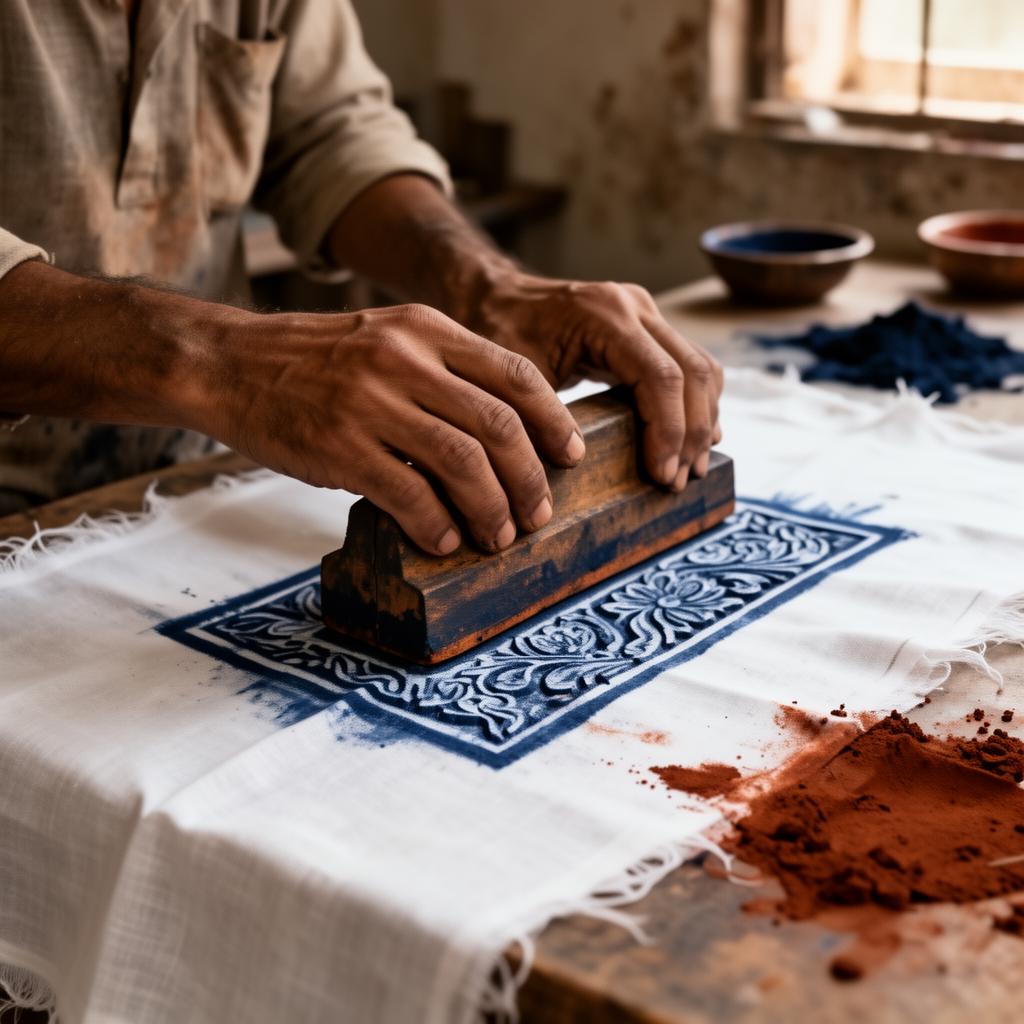
Pick up a piece of hand block printed cotton and hold it for a moment longer than you usually would. Feel the slight unevenness of the weave. Trace the edge of a printed flower with your fingertip. Notice the small breaks in the line where the wooden block lifted a fraction of a second too soon, or pressed a fraction too firmly.
What you are touching is not only cloth. It is a record of human attention — of a printer's hand, a carver's chisel, a dyer's patience, and a tradition that has been carried, season after season, across many hundreds of years.
In an age of machines that can print a kilometre of fabric in an afternoon, India has quietly continued to make some of its most beautiful textiles the way it always has: one wooden block, one motif, one pressed impression at a time.
“It is a record of human attention — of a printer's hand, a carver's chisel, a dyer's patience.”
The Origins of Hand Block Printing in India
India's relationship with textiles is older than most living traditions in the world. Archaeological excavations at Mohenjo-daro, a city of the Indus Valley Civilization that flourished between roughly 2600 and 1900 BCE, recovered fragments of cotton fabric and dyeing vats — among the earliest material evidence of cotton cultivation and textile dyeing anywhere on the planet.
From those ancient beginnings, Indian textiles travelled. By the early centuries of the common era, Indian printed and dyed cottons were already moving along trade routes to the Mediterranean, East Africa, and Southeast Asia. Indian cloth was prized in the courts of Rome, in the warehouses of Cairo, and later, in the merchant ports of Europe. The English word "chintz", in fact, comes from the Hindi chhint, a small printed or spotted cotton cloth.
Hand block printing as we recognise it today — wooden blocks carved with motifs and pressed by hand onto fabric — is documented across the subcontinent over many centuries. Different regions developed their own techniques, motifs, and palettes, often shaped by what grew nearby: the indigo plant in some areas, madder root in others, the iron-rich mud of certain riverbeds used as a mordant in still others.
Rajasthan, with its dry climate, soft river water, and long mercantile history, became one of the great centres of the craft. The desert state's printing villages — most famously Bagru and Sanganer, both within a short drive of Jaipur — refined block printing into the layered, deeply codified traditions still practised today.
Jaipur itself, founded in 1727 by Maharaja Sawai Jai Singh II, grew into the commercial heart of Rajasthani textiles. Royal patronage, a steady supply of skilled artisans, and easy trade routes to the rest of India turned the city, over generations, into the name most associated with Indian block printing around the world.
Meet the Artisan
To understand a single metre of hand block printed cotton, it helps to walk through the hands it passes through before it reaches you.
It begins with a design. A motif is drawn on paper — sometimes new, often a careful reinterpretation of a pattern that has been in the workshop's archive for generations. Indian printing studios keep these patterns the way other families keep recipes: known by heart, refined by use, rarely written down.
The design then travels to a block carver. Working in a quiet, sawdust-scented room, the carver selects a piece of well-seasoned hardwood — most often sheesham (Indian rosewood) or teak — which has been dried for months so it will not warp once it begins to absorb dye. With small steel chisels, the carver cuts away everything that is not the motif. The raised surface that remains will become the printed pattern.
A single complex design may require several blocks: one for the outline, one for the fill, separate blocks for each additional colour. Carving a full set can take a skilled artisan many days, sometimes weeks. The blocks are then soaked in oil to season them, and they will go on to print thousands of metres of cloth before they need replacing.
While the carver works, the cloth is being prepared. Lengths of cotton are washed to remove any factory starches, sometimes treated with a mild mordant so the dyes will hold, then stretched and pinned onto long, padded printing tables.
The dyes are mixed in shallow trays lined with bamboo mesh. The printer presses the wooden block into the dye, lifts it cleanly, places it onto the cloth, and strikes the back of the block firmly with the heel of the hand. The sound — a soft, rhythmic thud, repeated thousands of times a day — is the unmistakable percussion of a printing workshop.
Each impression is registered by eye. There are no machines guiding alignment, no lasers, no grids beyond the printer's own practised sense of distance. A border may run for several metres, motif after motif, without a single visible break. To watch this happen in person is to understand that the word skill does not quite capture what is happening.
Once printed, the fabric is moved into the sun to dry. From there it goes to the washing ghats — long stone steps along a river or tank where the cloth is rinsed in flowing water, beaten gently, and laid out again to dry in the open air. Some natural dyes deepen only after this washing; the cloth that emerges from the river is often quite different in tone from the cloth that went in.
Finally, the textile is finished — checked, pressed, trimmed — and sent on to the cutters and tailors who will turn it into a sari, a quilt, a curtain, or a bathrobe.
“The soft, rhythmic thud of block against cloth is the unmistakable percussion of a printing workshop.”
Why Every Handmade Print Is Unique
If you lay two pieces of hand block printed cotton side by side, you will find small differences between them. A motif may sit a millimetre higher in one place. A colour may be a shade deeper near the edge. A border may show a faint break where the block was re-inked mid-row.
These are not flaws. They are the signature of the hand.
Machine printing is designed to remove variation — every metre identical, every motif placed by software. Hand printing carries the opposite intention. It welcomes the small, honest evidence of how the cloth was made: the breath of the printer, the slight unevenness of natural dye, the warmth of a block that has been pressed thousands of times that day.
We say this gently, because mass-produced textiles have their place — they are affordable, accessible, and reliable. But a hand block printed cloth offers something different. It offers the quiet presence of the people who made it. When a print sits a hair off-centre, what you are seeing is a person, not a machine.
Living with handmade textiles teaches a particular kind of attention. You stop scanning for perfection and start noticing character. The cloth becomes more interesting, not less, the longer you keep it.
Bagru and Sanganeri: Two Traditions, One Region
Within Rajasthan, two villages near Jaipur have become almost shorthand for Indian block printing: Bagru and Sanganer. They share a craft, but each carries a distinct identity.
Sanganeri printing is the older and more refined of the two in many accounts, with a history that stretches back several centuries and a long association with royal commissions. Sanganeri prints are traditionally worked onto a white or off-white ground, with delicate, finely carved floral motifs known as buti — small flowers, paisleys, climbing vines — drawn from Mughal and Rajput design vocabularies. The palette is bright and clear: rose, indigo, gold, and soft greens. The cloth feels light, almost ornamental.
Bagru printing, from a village about thirty kilometres west of Jaipur, has a different character. It is most closely associated with two techniques: dabu, a mud-resist printing method in which a paste of clay, lime, and gum is applied to the cloth before dyeing, and syahi-begar, a process that uses iron-based black and an ochre yellow to create deep, earthy patterns. The Bagru palette is famously natural — indigo blues, alizarin reds, walnut browns, and the warm beiges of undyed cotton. Motifs lean towards bolder geometry, larger florals, and trailing vines.
Both traditions were granted Geographical Indication (GI) status by the Government of India — Sanganeri in 2010 and Bagru more recently — recognising them as crafts whose identity is inseparable from the place where they are made.
Today, the two styles have crossed and re-crossed each other many times. Many contemporary printers draw freely from both vocabularies, layering the delicacy of Sanganeri with the depth of Bagru. The result is a living, evolving design language that continues to shape modern Indian textiles — and, through them, contemporary interiors around the world.
Why Hand Block Printing Still Matters
It would be easier, in almost every measurable way, to print these textiles by machine. Faster, cheaper, more consistent, more scalable. And yet entire villages in Rajasthan continue to print by hand. Why?
Part of the answer is cultural. Hand block printing is one of the threads that keeps a particular kind of knowledge alive — the carver's eye, the printer's wrist, the dyer's instinct for when an indigo vat is ready. These are not things that can be written down in a manual. They are passed person to person, in workshops that often hold three generations of a single family at the same time.
Part of the answer is economic. The craft sustains thousands of artisans across Rajasthan and beyond — carvers, printers, washers, dyers, tailors, finishers. Each metre of hand printed cloth supports a chain of livelihoods that mass production simply does not require.
And part of the answer is, quietly, about the way we want to live. Slow craftsmanship invites us to choose fewer, better things — pieces that carry meaning, that improve with use, that connect us to the people who made them. There is a calm satisfaction in owning an object whose origin you can picture clearly.
We are careful here not to overstate the environmental case; every textile, however it is made, has some impact. But it is fair to say that a handmade cloth, used well and kept long, sits gently inside a more thoughtful relationship with what we bring into our homes.
“Slow craftsmanship invites us to choose fewer, better things — pieces that carry meaning and improve with use.”
Varnya's Philosophy
Varnya was not built around a product. It was built around a question: how do we make sure that the people, the techniques, and the stories behind India's living craft traditions continue to have a place in contemporary homes around the world?
We are a modern home and lifestyle brand, but our work begins in the same printing courtyards, the same artisan studios, the same family workshops that have shaped Indian craft for generations. We design for clean, contemporary interiors, but we do it in conversation with traditions that long predate us.
Every piece we make begins with an artisan, a technique, and a story worth keeping. Our role is to listen carefully, design thoughtfully, and bring that work to homes where it will be used, lived with, and loved.
Our Bathrobes
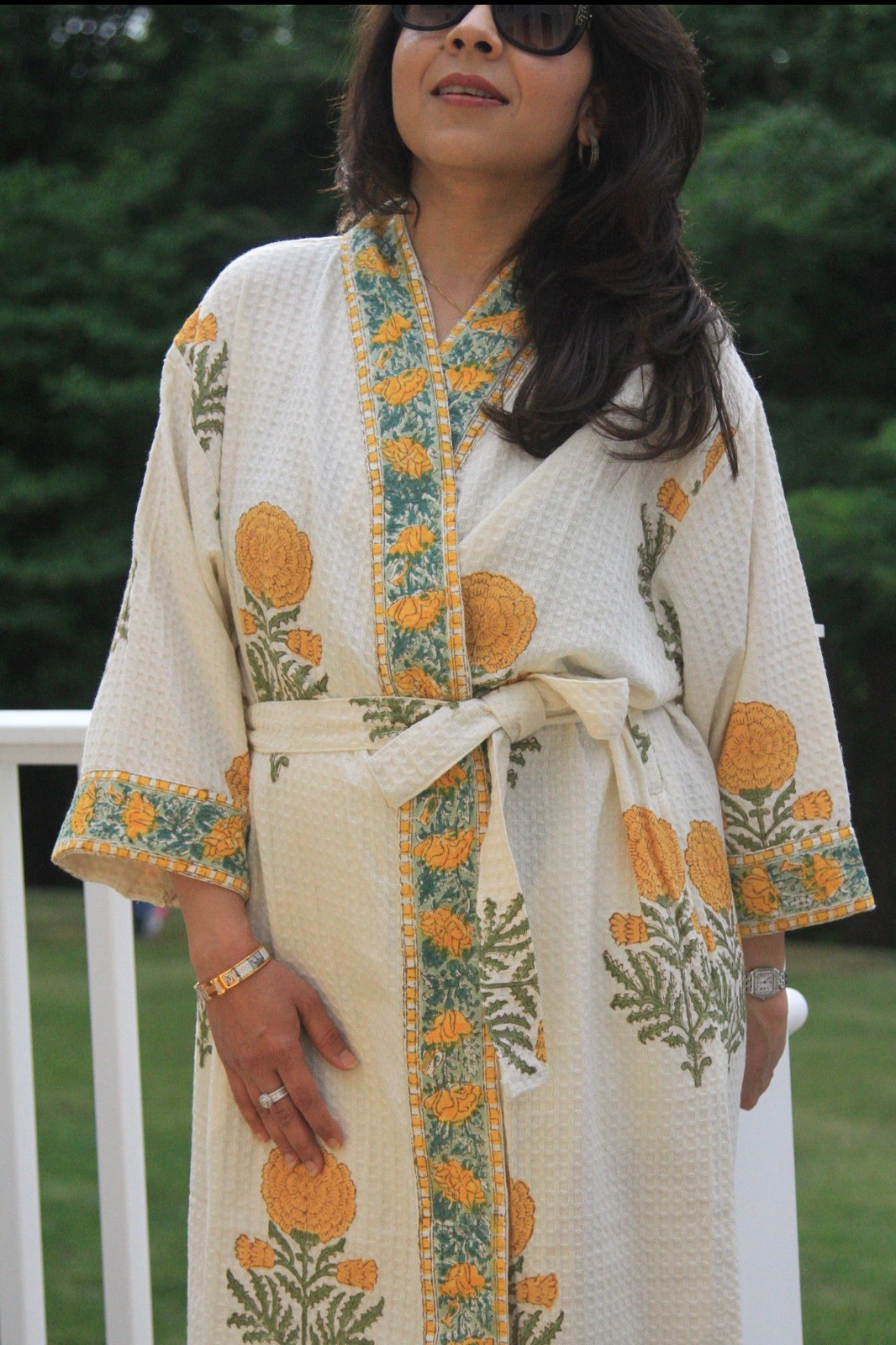
Our current collection of bathrobes is hand block printed in Jaipur, on 100% waffle cotton fabric. We chose waffle cotton specifically: it is soft, lightweight, breathable, and absorbent — comfortable in summer, cosy in winter, and increasingly soft with every wash.
Each robe is cut in a relaxed, mid-calf kimono shape with deep side pockets and a self-tie belt. The prints range from quiet florals and trailing vines to bolder geometric chevrons and classic indigo blooms — every motif carved, mixed, and pressed by hand in the workshops we work with in Jaipur.
Because each robe is printed by hand, no two are identical. Small variations in motif, alignment, and colour depth are part of the craft, not a flaw. We think of them as the maker's quiet signature — the small evidence that a person, not a machine, made this for you.
They are designed for the slow rituals of a modern life: a long morning, a quiet evening, a guest you want to take care of. They are made to be worn, washed, and worn again — for many years.



The Long Life of a Single Cloth
When you bring a piece of hand block printed cotton into your home, you are not only adding an object. You are joining a long, quiet conversation that began thousands of years ago in the cotton fields of the subcontinent, and continues today in workshops where the same wooden blocks are pressed into cloth, one careful impression at a time.
There is something deeply grounding about that. In a world that moves faster every year, owning something that was made slowly, by hand, by a person whose work you can imagine clearly, is a small but real act of care — for the maker, for the tradition, and for the way you want your own home to feel.
We hope, in some small way, that the cloth in your hands carries all of that with it.
Every Varnya collection is part of this longer effort — to preserve craftsmanship, support artisan communities, and bring meaningful handmade objects into contemporary homes around the world.
Continue reading
Field Notes · Bengal